|
|
SudoCue - Minimum Windoku Collection |
|
The program I wrote to find Sudoku-X puzzles with the minimum number of 12 (probably) clues has been adapted to broaden
the search to other variants, such as Windoku with a current 11 clues minimum and Windoku-X with a current 9 clues minimum.
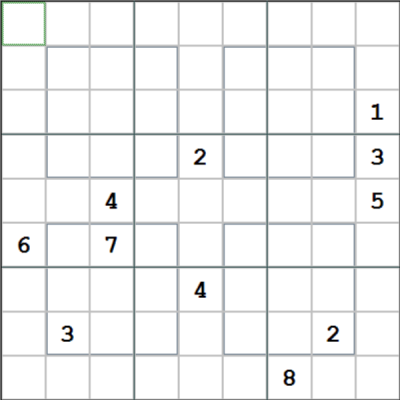
This Windoku starts with a series of 26 empty cells. It has only 11 clues and a unique solution. PuzzlesYou can download a zip with the current collection of 18778 windoku puzzles with 11 clues. Search methodI started with 40000 Windoku puzzles from my puzzle generator with 15 or fewer clues. With this collection, I performed the following steps:
Using this method, the first 11 clue results quickly appeared. Unlike Windoku-X, this variant is slowing down rapidly in the discovery of new 11 clues puzzles from the 12 clues collection, so I decided to give it new input. Hopefully there will be more results soon. Canonicalization method
The dihedral group (reflection & rotation) gives 8 equivalent puzzles. These transformations do not change the relative position of cells, but only operate on the complete puzzle. For each of the 256 (8 * 16 * 2) available transformations, the clues are renumbered in order of appearence and compared with the best result so far, replacing it when better. I will continue to look for more 11-clue puzzles, as long as some progress can be made. If you like to contribute any 11-clue Windoku puzzles that you have found, I will gladly add them to the collection. |
| © 2005-2021, Ruud ~ Sitemap ~ Contact ~ Privacy policy ~ |  |
 |
![[Valid RSS]](images/valid-rss.png "Valid RSS feed") |
Views: 432 |